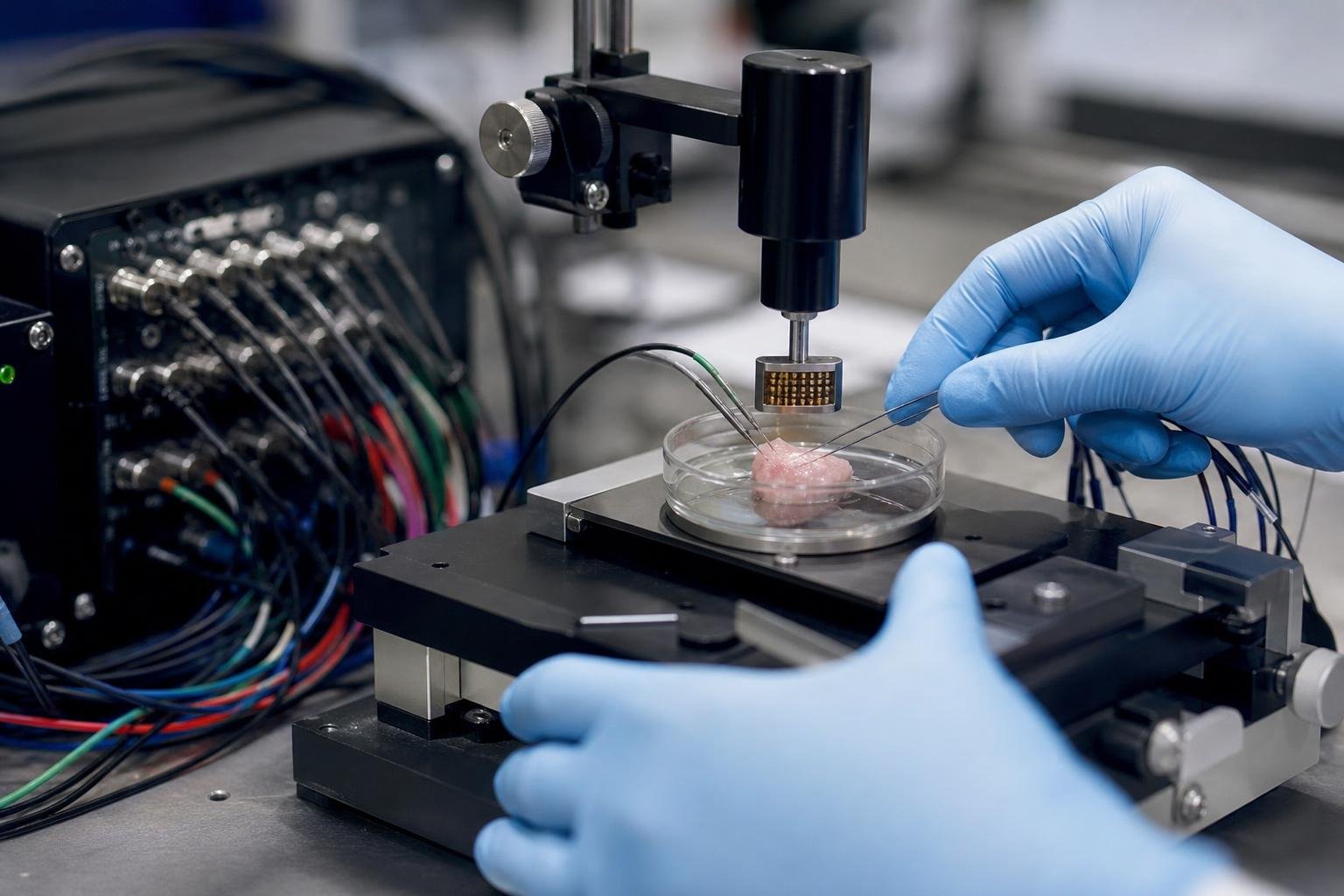
Researchers at the University of Bristol have connected miniature brain organoids to a tactile sensor that received patterns associated with Braille letters, then used a computer decoder to distinguish the neural activity produced by those inputs. The work demonstrates a basic but consequential engineering capability: living neural networks can be linked to an external sensing system and generate responses that are sufficiently structured to be decoded. [1]
The result is not evidence that organoids can read, understand language, or function as miniature conscious computers. It is an early biohybrid interface experiment. Its importance lies in the closed chain it establishes: a physical stimulus is sensed, converted into a signal delivered to living tissue, and interpreted from the tissue’s changing activity by conventional computation. That chain could become useful for studying biological learning and for designing future interfaces between electronics and neural tissue.
What the Bristol experiment demonstrated
The Bristol team used brain organoids—laboratory-grown clusters of neural tissue—as the biological element in a system coupled to a tactile sensor. The sensor received patterned inputs associated with Braille letters. The organoids responded with distinct patterns of neural activity, and a computer-based decoder identified those differences. [1]
That arrangement matters because the neural tissue was not studied only as an isolated culture. It was incorporated into an input-and-output pipeline. The tactile sensor provided a repeatable, structured source of information; the organoids produced measurable biological signals; and software classified the resulting activity. In engineering terms, the work tests whether a living network can be treated as a responsive component within a larger instrument.
Braille-like patterns are a sensible test input for this kind of study. They are discrete, spatially structured and straightforward to vary. A system that responds differently to such patterns can be evaluated more clearly than one exposed to less controlled real-world stimuli. The use of a decoder is equally important: a biological response only becomes operationally useful when it can be measured and consistently distinguished from other responses.
Lena Smirnova
Brian S. Caffo
David H. Gracias
Qi Huang
Itz, CC BY 4.0, via Wikimedia Commons
Why this is a biohybrid milestone, not a silicon replacement
The experiment belongs to the emerging field of biohybrid systems, which combine living cells or tissues with electronic sensors, recording equipment and software. The immediate contribution is not a new general-purpose processor. Silicon systems remain vastly more practical for reliable, scalable and high-speed computation. They are manufactured to defined specifications, do not require cell culture and can be deployed in products at industrial scale.
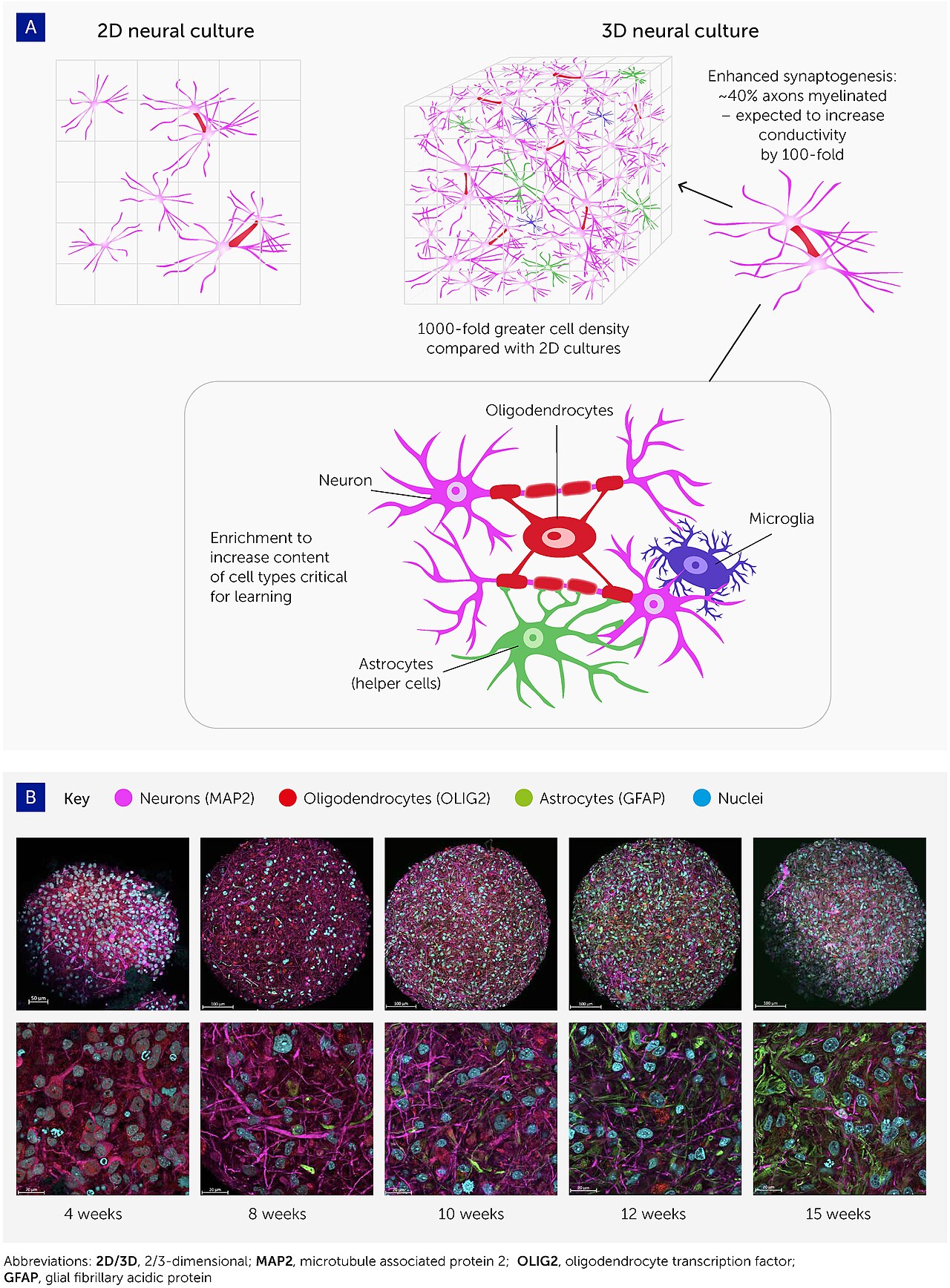
Living neural tissue offers a different research opportunity. Neural networks develop through biological processes, operate with rich internal dynamics and can change their responses over time. Connecting those networks to controlled inputs allows researchers to investigate how biological systems represent signals, adapt to repeated stimulation and potentially learn under defined experimental conditions.
The Bristol result should therefore be interpreted as a platform demonstration. It shows that researchers can bridge three domains that are often studied separately: physical sensing, living neural activity and machine decoding. The practical question now is not whether an organoid can replace a computer, but whether this platform can yield reproducible experiments that reveal useful principles of biological information processing.
From brain organoid research to instrumented neural systems
Brain organoids have primarily been used as laboratory models for studying aspects of neural development, disease and drug responses. Their value is that they can provide a more biologically relevant system than simple cell cultures while remaining more experimentally accessible than a human brain.
Adding external sensors and computational decoders expands the scope of those models. Instead of observing tissue only after a treatment or at selected recording points, researchers can supply structured stimuli and observe how activity changes in response. Repeated tests could help examine questions such as whether responses remain stable, whether exposure alters later activity and which signal characteristics are most reliably represented in a neural network.
The approach also highlights the continuing role of conventional computing. The tactile sensor, data-acquisition equipment and decoder are not peripheral details; they are essential to the result. The organoid is one component in a hybrid measurement system, while electronics and software deliver controlled inputs, capture outputs and determine whether those outputs can be classified.
Technical hurdles will determine whether the approach advances
The central challenge is reproducibility. A useful biohybrid platform must show that its responses can be measured consistently across trials and, eventually, across separately grown organoids. Biological preparations naturally vary. That variability can be informative for biology, but it is a major obstacle for any system intended to function predictably.
Researchers will also need to separate decoding from learning. A machine-learning decoder may identify differences in neural activity even when the organoid has not changed its behavior through training. Demonstrating biological learning would require carefully designed experiments that compare responses over time, include appropriate controls and show that changes in performance arise from the living tissue rather than from adjustments in the software analysis.
Input and output resolution are further constraints. Future studies will need to establish how many distinct patterns can be delivered, how reliably activity can be recorded, how long the tissue remains viable and whether responses endure after repeated stimulation. Those questions are more important than a provocative claim that organoids are “computing.” They determine whether a demonstration can become a dependable research tool.
Ethical oversight must develop alongside the instrumentation. The Bristol work does not establish consciousness or perception in organoids, and it should not be described as doing so. Still, increasingly sophisticated stimulation, recording and adaptive experiments raise legitimate questions about governance, donor consent, welfare standards and the language used to communicate results. Clear boundaries and transparent reporting will be necessary as organoid capabilities and experimental complexity grow.
Industry implications: enabling tools before end products
The nearer-term commercial implications are likely to be found in research infrastructure rather than consumer computing. Laboratories working with organoids may benefit from better tactile, optical or chemical stimulation systems; improved electrophysiology and signal-recording tools; and software that can analyze complex biological responses. Companies supplying cell-culture platforms, sensors, neural interfaces and scientific data tools could all have a role in this ecosystem.
For pharmaceutical and neuroscience research, instrumented organoids could eventually support more dynamic experiments than static endpoint measurements. The potential benefit would be a controlled way to test how neural tissue responds to patterned inputs, disease-related conditions or candidate interventions. That possibility remains exploratory and will depend on validation against established biological models.
There is no immediate product market for organoid-based computing hardware. The requirements of maintaining living tissue—specialized culture conditions, quality control, limited longevity and regulatory scrutiny—make it poorly suited to conventional computing deployments. The credible business opportunity at this stage is in the tools that make biohybrid experiments more repeatable, measurable and comparable.
What comes next
The next meaningful demonstrations would test whether the Bristol setup can do more than distinguish preselected patterns. Researchers may seek evidence that responses can be trained, retained, generalized to related inputs or altered in a controlled way by feedback. They will also need to show how performance varies between organoids and how much of the system’s apparent capability comes from the biological network versus the decoder.
If those experiments succeed, the field could gain a more capable testbed for biological learning. Rather than treating neural tissue as an opaque sample, scientists could interrogate it with defined sensory-like inputs and quantify the outputs continuously. That may inform future neural-interface design, disease modeling and basic neuroscience.
For now, the Bristol project is best understood as a carefully bounded advance in coupling biology to electronics. It does not make organoids into readers or replace digital processors. It does, however, provide evidence that living neural networks can participate in a measurable sensing-and-decoding loop—and that is a useful foundation for the next generation of biohybrid experiments.
Editor’s Take
I see the strongest value here in the experimental architecture, not the Braille headline. A tactile input, living neural response and software decoder create a test loop that engineers can improve piece by piece. Better stimulation control, cleaner recordings and more rigorous validation could make organoids more useful as dynamic research models.
The next result worth watching is a controlled demonstration of biological adaptation: the same tissue should improve or change its responses over time under a predefined training protocol, while the decoding method stays fixed. Until then, claims about biological computing should remain modest. The real opportunity is to build dependable tools for studying neural behavior, not to market living tissue as a rival to chips.