Neuralink’s most consequential advances in 2025 were clinical-trial milestones, not breakthroughs in Tesla technology. The brain-computer-interface company is separately held and is not a Tesla subsidiary; Tesla identifies Elon Musk as a Neuralink founder but has not announced a Neuralink product integration, shared commercial platform or Neuralink control system for Tesla vehicles or Optimus robots. [1]
That distinction matters because Neuralink’s public progress is real but still investigational. By November 5, the company had expanded human implants, demonstrated wireless computer control, begun work on robotic-arm control and secured FDA Breakthrough Device designations for speech and vision programs. None of those steps establishes commercial availability, broad human enhancement, or a Tesla-linked product.
1. Wireless computer control moved from a first implant to a small user group
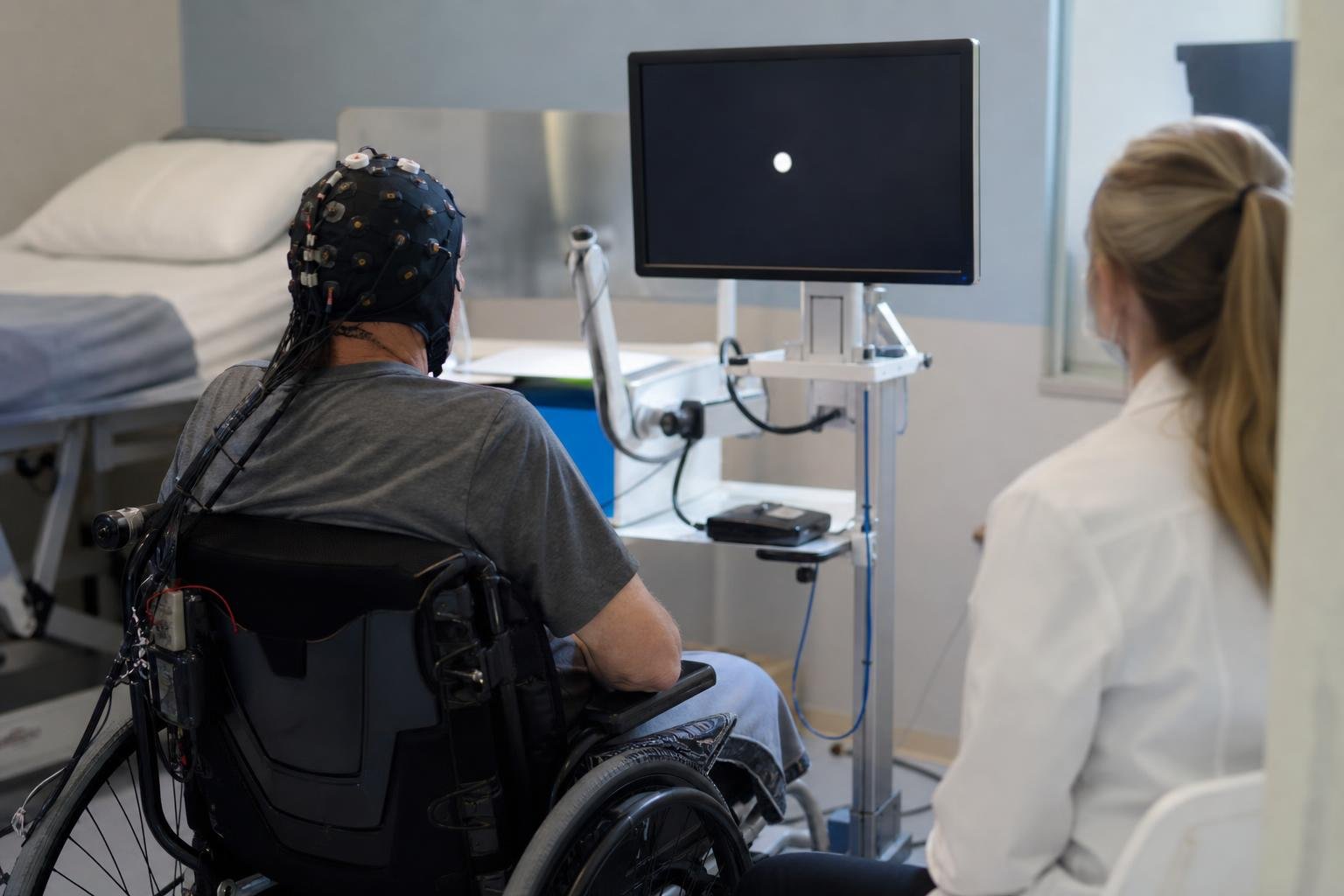
Neuralink’s flagship milestone is its Telepathy brain-computer interface program. Noland Arbaugh, who has paralysis following a spinal-cord injury, received the first publicly known Neuralink implant in January 2024. The PRIME Study is evaluating the N1 device in people with quadriplegia caused by spinal-cord injury or ALS.
The N1 is a fully implanted wireless interface that records electrical activity associated with intended movement. Software translates those signals into commands for a computer or smartphone. The device uses more than 1,000 electrode channels on flexible threads, which are inserted by Neuralink’s surgical robot while seeking to avoid blood vessels. [2]
In February, Neuralink said three participants — Arbaugh, Alex and Brad Smith — had received implants. The company reported more than 670 cumulative implant-days and 4,900 hours of use, with participants using the system to operate cursors, on-screen keyboards and applications. [2] By September, Neuralink said 12 people worldwide had received its implants, accounting for more than 2,000 cumulative device-days and 15,000 hours of use. [3]
Those figures are meaningful evidence that the company has moved beyond a single public demonstration. They are not, however, a peer-reviewed clinical dataset. Neuralink has not publicly released comprehensive standardized results on long-term signal stability, error rates, training time, device failures or comparative performance against other implanted BCIs.
2. The CONVOY study extended the goal from screens to physical tasks
In November 2024, Neuralink launched the CONVOY Study, a feasibility trial examining whether the N1 can be used to control an assistive robotic arm. The goal is to move from digital autonomy — navigating a computer, communicating and using a phone — toward assistance with physical tasks such as grasping objects or feeding oneself. [4]
Alex, one of the early PRIME participants, also enrolled in CONVOY and used the system to control an assistive robotic arm, according to Neuralink. By June, the company said five people with severe paralysis were using its implants to control digital and physical devices. [5]
This is an important expansion of the technology’s potential utility, but it needs careful framing. An assistive-arm feasibility study is not evidence that Neuralink users are controlling Tesla’s Optimus humanoid robot. No reliable public evidence available by the November 5 dateline showed a Neuralink participant remotely operating or “inhabiting” an Optimus robot.
The broader concept of brain-controlled assistive devices is also not unique to Neuralink. Academic researchers and competing companies have previously demonstrated robotic-limb control and other BCI capabilities. Neuralink’s contribution is its particular combination of high-channel-count flexible threads, wireless electronics, decoding software and robotic implantation.
3. The FDA gave the speech-restoration program a faster development pathway
On May 1, Neuralink announced that the FDA had granted Breakthrough Device designation to its speech-restoration program. The program is intended for people with severe speech impairments associated with conditions including ALS, stroke, spinal-cord injury, cerebral palsy and multiple sclerosis. [6]
The technical objective is to decode neural activity associated with attempted speech and convert it into text or synthesized voice. For people who can no longer speak reliably, a system that reduces the effort and delay involved in communication could be clinically significant.
But Breakthrough Device designation is not FDA approval, clearance or authorization to market a product. It is a regulatory pathway designed to give developers more interaction with FDA reviewers and potentially prioritized review when a device targets serious conditions and unmet needs. Safety and effectiveness must still be established through the development and review process. [7]
As of November 5, Neuralink had not publicly provided a validated human speech-decoding accuracy rate or clinical evidence demonstrating restoration of fluent speech. The designation signals regulatory interest in the intended use, rather than proof that the technology has achieved its clinical objective.
4. Blindsight received a separate FDA designation for a cortical visual prosthesis
Neuralink’s Blindsight program received FDA Breakthrough Device designation in September 2024. It is an experimental visual prosthesis designed to stimulate the visual cortex directly, rather than depend on the eye or optic nerve. [8]
That approach could eventually be relevant to people whose vision loss cannot be addressed by retinal or optic-nerve therapies. However, the designation did not mean Neuralink had restored vision, cured blindness or gained authorization to sell the implant. It likewise did not validate Musk’s more expansive future-facing statements about providing sight to people who have lost both eyes or optic nerves, or who were born blind.
Cortical visual-prosthesis research predates Neuralink, and substantial scientific and engineering challenges remain. Creating useful visual perception requires far more than delivering stimulation to the brain: researchers must establish durable hardware, safe stimulation parameters and meaningful visual outcomes for participants. The program’s Breakthrough designation makes it one of Neuralink’s most prominent long-term medical bets, not a completed clinical success. [8]
5. Financing and international trials gave Neuralink a larger clinical footprint
Neuralink announced a $650 million Series E financing round on June 2, saying the capital would support clinical expansion and work on vision, speech and physical-device control. The round included investors such as Founders Fund, Sequoia Capital, QIA, ARK Invest, Thrive Capital, Lightspeed and Vy Capital. [5]
The company also broadened its network of clinical sites and partners, including Barrow Neurological Institute in Phoenix, the Miami Project to Cure Paralysis at the University of Miami, University Health Network and Toronto Western Hospital, and Cleveland Clinic Abu Dhabi. In July, Neuralink announced the GB-PRIME Study in Great Britain, with sites at University College London Hospitals NHS Foundation Trust and Newcastle upon Tyne Hospitals NHS Foundation Trust. [9]
International expansion and a larger implanted cohort are operational achievements: they give the company more opportunity to test surgery, hardware reliability, training and real-world use across patients and care settings. Still, the program remains investigational. There was no public evidence by the dateline of a completed pivotal trial, broad clinical adoption or a commercially available Neuralink implant.
What Neuralink’s progress does — and does not — show
Neuralink is operating in an increasingly competitive BCI sector, not creating the category from scratch. More than 45 active BCI trials were reported in early 2025, with companies including Synchron, Blackrock Neurotech, Precision Neuroscience and Onward Medical pursuing different approaches. [10]
Neuralink may be differentiated by its vertically integrated design: flexible electrode threads, a custom surgical robot, high channel count and a fully implanted wireless device. Yet that design requires open-brain surgery, a significant trade-off relative to less invasive alternatives such as Synchron’s endovascular Stentrode. University of Washington neurotechnology researcher Rajesh Rao has described Neuralink’s robotic flexible-thread implantation as potentially distinctive, while cautioning that its comparative advantages have not been proven. [10]
Independent experts have also emphasized the evidence gap. Marco Baptista of the Christopher & Dana Reeve Foundation characterized BCIs as high-risk, high-reward technology and said it remains too early to know which approaches will prove safest and most feasible. Critics have questioned Neuralink’s transparency, speed and animal-testing record; reports of animal-welfare concerns and calls for scrutiny are not findings that the human device is unsafe, but they underscore why rigorous public clinical evidence matters. [2][10]
Musk’s wider vision links BCIs to human enhancement, AI interaction and robotics. Neuralink’s verified record through November 5 is narrower and more immediate: a small but growing group of participants using an experimental implant to control digital tools, early work on physical-device control, and regulatory-development pathways for speech and vision applications. The near-term test is whether those promising demonstrations become reproducible, safe and durable clinical benefits.
Editor’s Take
The useful story here is not human enhancement or Tesla integration; it is the slow conversion of an impressive lab-and-demo platform into a clinical product for people with paralysis. A dozen implants and thousands of use hours are meaningful operational progress, especially for a fully implanted wireless system, but they do not yet answer the commercial questions that matter: long-term reliability, revision rates, signal durability, training burden and performance against less invasive competitors.
I am encouraged by the move from cursor control toward assistive-arm control, because that is where a BCI begins to create practical daily value rather than just an impressive demo. The next milestones worth watching are independently reported participant outcomes, durable speech-decoding results, and repeatable physical-task performance. FDA Breakthrough designations and a $650 million round improve Neuralink’s odds of moving faster, but neither substitutes for clinical evidence or establishes a Tesla product connection.
References
- Tesla Investor Relations — https://ir.tesla.com/corporate/elon-musk
- IEEE Spectrum, “Neuralink Human Trials” — https://spectrum.ieee.org/neuralink-human-trials
- Investing.com, “Musk’s Neuralink says 12 people have received its implants” — https://www.investing.com/news/world-news/musks-neuralink-says-12-people-have-received-its-implants-4232383
- Neuralink, “CONVOY Study Launch” — https://neuralink.com/updates/convoy-study-launch/
- Neuralink, “Neuralink Raises $650M Series E” — https://neuralink.com/updates/neuralink-raises-650m-series-e/
- Neuralink, “Neuralink Receives Breakthrough Device Designation for Speech” — https://neuralink.com/updates/neuralink-receives-breakthrough-device-designation-for-speech/
- U.S. Food and Drug Administration, “Breakthrough Devices Program” — https://www.fda.gov/medical-devices/how-study-and-market-your-device/breakthrough-devices-program
- Neuralink, “Neuralink Receives Breakthrough Device Designation for Blindsight” — https://neuralink.com/updates/neuralink-receives-breakthrough-device-designation-for-blindsight/
- Neuralink, “GB-PRIME Study Launch” — https://neuralink.com/updates/gb-prime-study-launch/
- Associated Press, “Neuralink and the Brain-Computer Interface Field” — https://apnews.com/article/elon-musk-neuralink-brain-computer-interface-9dbc92206389cf1597ee5