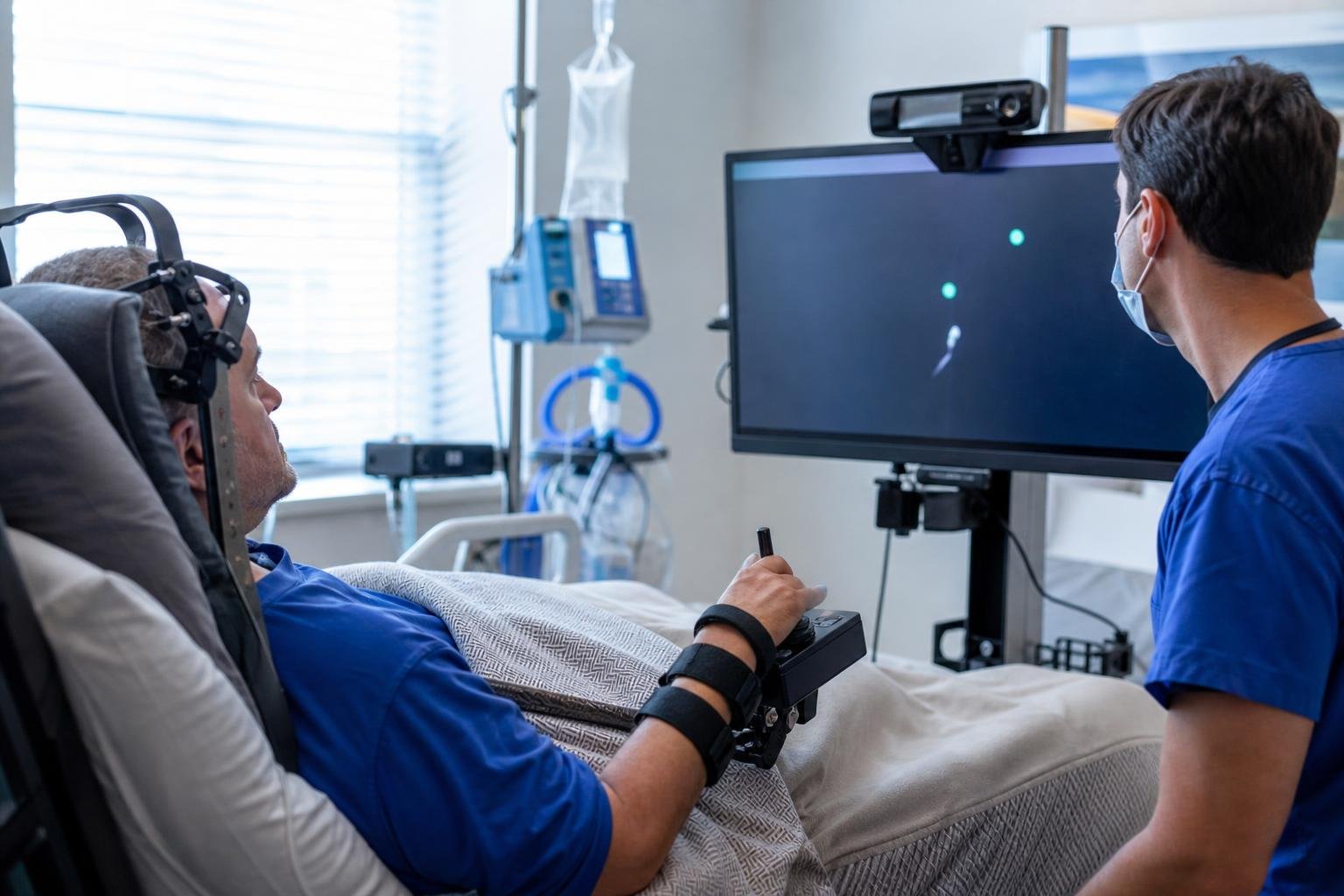
Paradromics has received FDA authorization to expand the investigational use of its Connexus brain-computer interface (BCI), allowing researchers to connect the speech-restoration system with additional personal devices. The change is important because it moves the clinical question beyond whether neural activity can be decoded into words and toward whether that output can work through the devices that shape everyday communication.
The authorization is not permission to sell Connexus or a declaration that the implant is safe and effective for broad clinical use. It expands the scope of a clinical investigation. But that distinction should not obscure the practical significance: a speech BCI only becomes a useful communication system when a person can use its output reliably with the computers, communication tools, and other personal technology involved in daily life. Paradromics is studying the implant in people with severe motor impairment; its first participant has trained the system on thousands of words and sentences, according to MassDevice.[1]
- 1 reported first study participant trained on the Connexus system
- Thousands of words and sentences used in that participant’s training
- Additional personal devices now within the expanded investigational scope
What the FDA authorization changes
For an implanted BCI, an FDA investigational authorization governs what researchers may study, in whom, and under what safeguards. It can cover changes to study protocols, hardware configurations, software, data collection, and the external systems connected to an investigational implant. Paradromics’ expanded authorization concerns compatibility with additional personal devices, rather than a general consumer launch.[1]
That matters because the external device is not incidental. A neural decoder may turn intended speech into text, synthetic voice, or computer commands, but the benefit to a user depends on where that output goes and what it can control. A connection to a personal device could enable researchers to assess whether decoded communication can move through more realistic workflows than a narrowly configured laboratory interface.
The authorization does not mean Connexus has received FDA marketing authorization, prescription availability, or a broad safety-and-effectiveness finding for people with paralysis or other severe motor impairments. It also does not establish that any particular consumer device, operating system, or application has been validated for routine use. Clinical investigators still must demonstrate performance and manage the risks of an implanted system and its connected software.
Why device compatibility is a meaningful BCI milestone
Speech-restoration BCIs have produced striking research demonstrations: systems can infer intended words or phonemes from brain signals and render them as text or synthesized speech. Yet a demonstration is often conducted with fixed equipment, a limited vocabulary or controlled task, and researchers available to recalibrate the system. Daily communication presents a harder test.
A usable system must work when the person wants to converse with family, answer a message, use a computer, or navigate a communication application. It must preserve low enough latency that conversational turn-taking remains natural. It must handle decoding errors in a way that lets the user correct or confirm output without creating an exhausting feedback loop. And it must continue to work as neural signals, user behavior, and software environments change.
Compatibility testing addresses the final, frequently underestimated portion of that chain: the path from decoded intent to useful action. Researchers can examine whether the interface maintains acceptable performance when connected to the personal technology a participant actually depends on, rather than only a dedicated clinical setup. That is a necessary step in translating BCI research into assistive communication, even if it is not sufficient by itself.
The technical stack is broader than the implant
Connexus is designed as an implanted BCI that records neural activity and uses software to decode intended communication. In a speech-restoration application, the system must distinguish patterns associated with attempted or intended speech, map those patterns into language output, and deliver that output through an external interface.
Each stage creates a separate engineering problem. Signal acquisition must remain stable after implantation. Decoding models require enough training data to recognize a user’s intended language and adapt without unexpectedly degrading performance. Language modeling may improve fluency, but it can also risk substituting a plausible phrase for what the user meant. The user interface must make the system controllable, transparent, and correctable. Device integration adds authentication, permissions, operating-system changes, accessibility settings, connectivity, and cybersecurity to the clinical reliability problem.
The report that the first Connexus participant has trained on thousands of words and sentences indicates the scale of personalization involved in developing a decoding system.[1] It does not, on its own, establish accuracy, vocabulary coverage, error rate, latency, durability, or independence from researchers. Those measures will be central to judging clinical usefulness as the study progresses.
Who stands to benefit—and what researchers need to prove
Paradromics is developing Connexus for people with severe motor impairment, a group that can include individuals whose ability to speak or use conventional input devices is substantially limited.[1] For such users, communication speed and reliability are not product conveniences; they determine whether the technology can support social relationships, clinical care, work, and independent decision-making.
The key organizations in this development are Paradromics, which is sponsoring the Connexus program, and the FDA, which oversees the investigational framework for the implant. Most importantly, the clinical participants and care teams are central to evidence generation: their outcomes will determine whether device compatibility translates into meaningful gains rather than a broader but still cumbersome research setup.
Researchers will need to evaluate more than word production. Important practical endpoints include whether users can initiate and stop communication confidently; how often they must correct output; whether the system functions across sessions; the time and specialist support required for setup and retraining; and whether connection to personal devices creates new points of failure. For an implanted communication aid, surgical safety, long-term signal quality, hardware reliability, privacy, and data security remain fundamental concerns.
Competitive and market implications
The BCI sector is shifting from a focus on raw neural decoding toward complete assistive systems. The eventual market is not simply implants. It includes surgical delivery, external hardware, decoding software, speech synthesis, accessibility interfaces, clinical support, reimbursement, and long-term service. A product that delivers impressive output in a trial but cannot fit into a user’s existing technology environment will have limited practical value.
Paradromics’ expanded investigational scope therefore signals an effort to compete on system integration as well as neural performance. It gives the company an opportunity to produce clinical evidence about how Connexus works beyond a single prescribed endpoint. For hospitals, payers, and future users, evidence of successful real-world device integration could ultimately be as consequential as headline decoding speed.
There are also commercial constraints. Personal-device support can fragment quickly across platforms, software versions, accessibility features, and security requirements. Maintaining dependable compatibility is expensive, particularly for a regulated medical system. Any future commercial offering would need clear boundaries around supported configurations, maintenance responsibilities, data handling, and the consequences of software updates. The FDA’s investigational expansion allows those questions to be studied; it does not solve them.
What to watch next
The next meaningful disclosures from Paradromics will be performance evidence rather than compatibility claims alone. The most useful data would show how accurately and quickly participants communicate, how performance changes over time, how much calibration is required, what happens when users make corrections, and whether the system works with personal devices outside highly supervised sessions.
It will also be important to learn how broadly the expanded authorization is being used. A demonstration of neural output appearing on another device is a modest integration milestone. A repeatable workflow in which a participant can independently communicate through the tools they rely on would be a more substantial clinical advance.
The broader lesson for the BCI field is straightforward: decoding is necessary, but it is not the product. For speech restoration, the product is dependable communication in the context of a person’s life. Paradromics’ FDA authorization creates a path to test that proposition in a clinical study.
Editor’s Take
I see this as a more consequential milestone than another isolated speech-decoding demonstration. The difficult commercial work starts after a BCI produces words: getting those words into a user’s real communication workflow, making correction easy, and ensuring an operating-system update or a dropped connection does not take away someone’s voice. Expanding investigational compatibility is where that work can begin under clinical oversight.
The claim to watch is not that Connexus can connect to more devices; that is only an enabling condition. The stronger proof would be data showing that participants can communicate independently, repeatedly, and with manageable setup and correction burden. Until then, commercial expectations should remain disciplined. Still, moving this question into the clinical protocol is exactly the kind of practical step that can turn a promising implant into an assistive system people can live with.