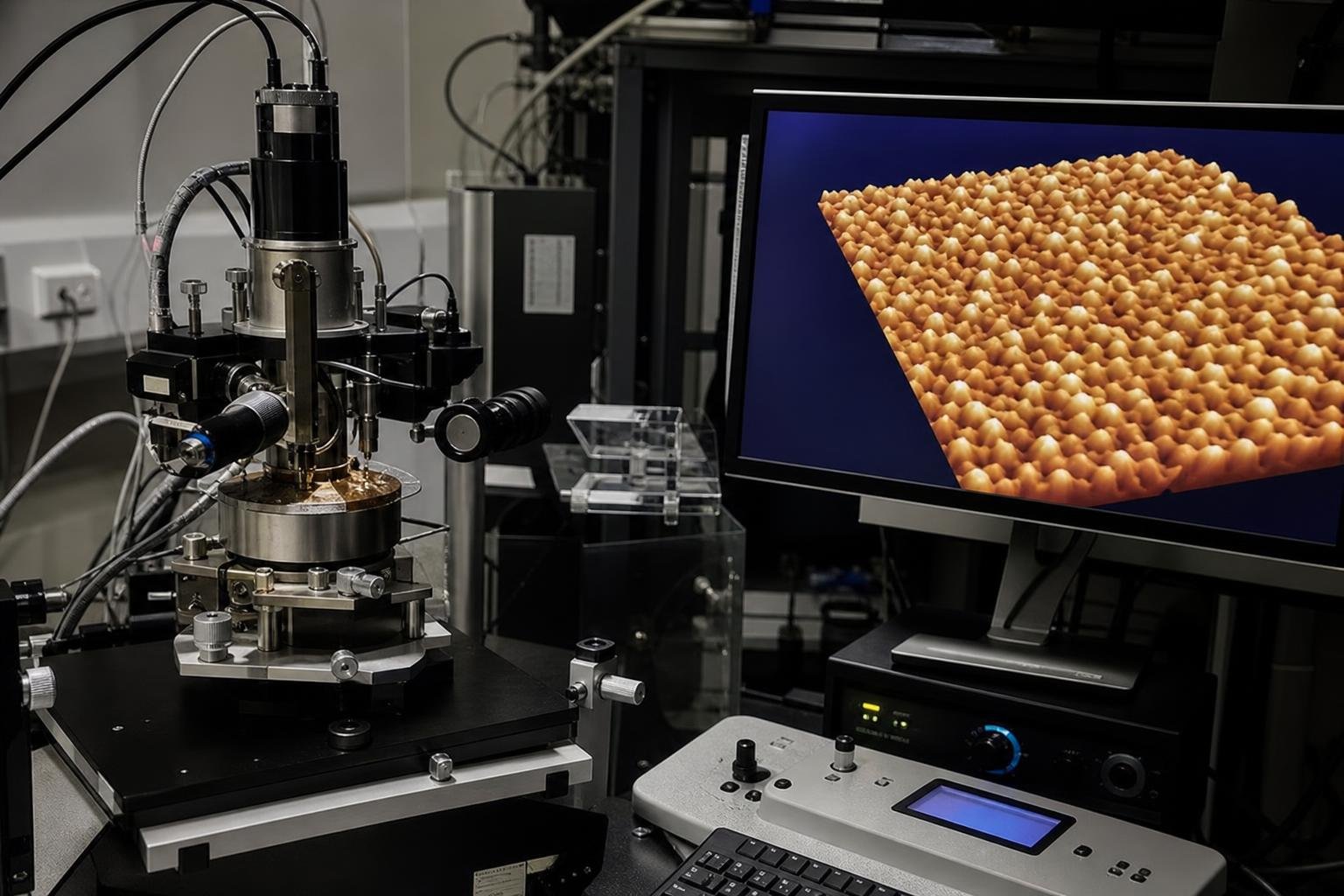
Oak Ridge National Laboratory researchers have demonstrated an autonomous system that uses computer vision and artificial intelligence to guide a microscope tip as it moves individual molecules across a copper surface. The system reportedly operated for more than 25 hours while producing atom-scale patterns, linking imaging, decision-making and physical manipulation in one closed-loop workflow.[1]
The important advance is not simply that AI was applied to a microscopy task. AI is routinely used to classify images, analyze experimental data and suggest candidate materials. Here, it is positioned in the control loop: the software interprets what the instrument sees, chooses a next action and directs a physical tool at molecular scale. Sustained autonomous operation is the more meaningful result because atom-by-atom manipulation has traditionally depended on intensive human attention, expert judgment and frequent correction.
By the numbers
- More than 25 hours: Reported duration of autonomous system operation.
- 1 microscope tip: The physical actuator used to move molecules on the surface.
- 1 copper surface: The substrate used for the reported molecular-patterning demonstration.
From image recognition to physical control
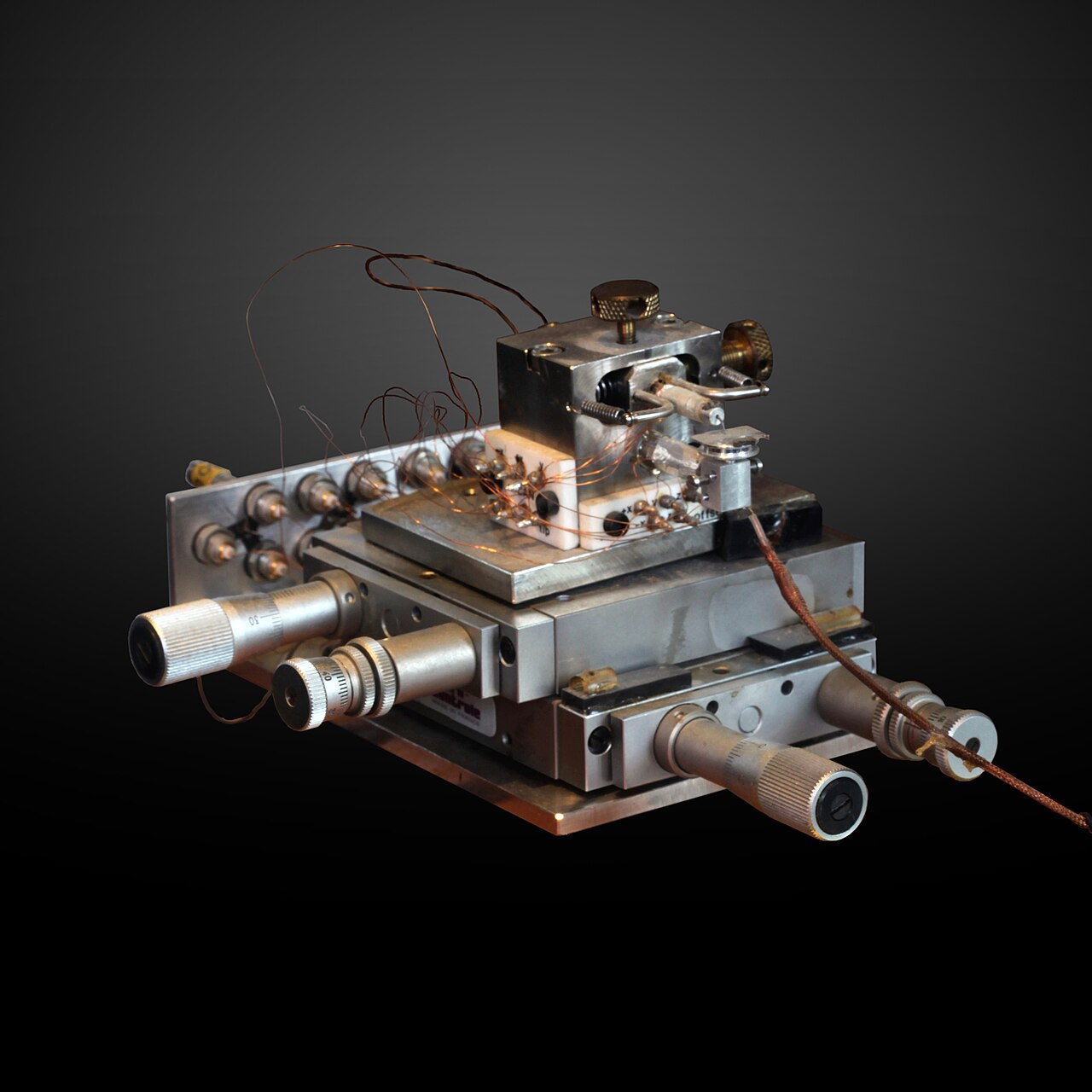
The ORNL work centers on a scanning-probe-style approach to surface manipulation. Such instruments use an extremely sharp tip positioned near a material surface. By precisely controlling the tip’s location and its interaction with an adsorbed molecule, an operator can move that molecule to a selected position. This class of experiment has long made it possible to arrange matter at exceptionally small scales, but it is demanding: the system must distinguish relevant features in microscopy images, select targets, plan movements, verify whether an action worked and recover from errors.
ORNL’s system combines computer vision with AI-based decision-making to automate those functions. Computer vision supplies the perception layer, identifying molecular-scale features in microscope images. The AI control layer then converts that interpretation into commands for the microscope tip. The subsequent image provides feedback, allowing the system to determine whether the intended move occurred and choose the next step.
That closed loop—see, decide, act and verify—is what separates the project from a conventional AI-for-science pipeline. In many materials programs, machine learning ranks compounds or predicts properties, while human researchers still carry out experimental work. In this demonstration, the software participates directly in the experiment by commanding the tool that rearranges matter.
Why 25 hours of autonomy matters
A short autonomous sequence can demonstrate that a controller works under favorable conditions. Operating for more than 25 hours is a stronger, though still early-stage, test of robustness. Over long runs, a microscopy-control system must cope with image drift, changes in tip condition, positioning errors, imperfect manipulation outcomes and the possibility that its visual model misidentifies a feature.
For atom-scale assembly to become a useful laboratory capability rather than a specialist demonstration, it must reduce the dependence on a researcher continuously watching images and issuing corrections. Long-duration operation suggests that ORNL has addressed at least part of that operational challenge. It also creates a basis for collecting systematic records of attempted moves, successful placements and failure modes—data that can improve later control policies.
The distinction matters for productivity. A skilled microscopist can produce remarkable structures, but manual manipulation is inherently difficult to scale because attention is the bottleneck. An autonomous controller could eventually run repetitive assembly tasks outside normal working hours, make experiments more repeatable across operators and free researchers to focus on selecting structures and interpreting their behavior.
What the result could enable
The near-term opportunity is in research, not production. Precisely constructed molecular arrangements can help scientists study how electronic states, magnetic interactions and quantum effects change when atoms or molecules are placed at deliberately chosen separations. Copper is a useful model surface for this kind of controlled experiment, while the broader scientific goal is to create and test structures that are difficult to obtain through conventional bulk synthesis.
ORNL points to potential applications in electronics and quantum materials.[1] At the research level, autonomous placement could accelerate experiments on engineered molecular devices, surface-supported electronic structures and model quantum systems. The value is not merely the ability to make a visually striking pattern. It is the ability to make a defined pattern repeatedly, characterize it and alter one variable at a time.
That capability could improve experimental design. Instead of fabricating a large batch of nominally similar samples and hoping a desired local configuration appears, a lab may be able to build a sequence of controlled arrangements and measure their properties one by one. In principle, that creates a tighter feedback loop between theory, measurement and construction.
The gap between a microscope demonstration and manufacturing
The announcement should not be confused with a new method for manufacturing electronic chips or quantum hardware at commercial scale. Moving individual molecules with a microscope tip is fundamentally different from producing billions of devices with high yield. Throughput is the central constraint: a serial tip-based process performs operations one target at a time, whereas semiconductor fabrication depends on massively parallel patterning, deposition and etching.
Several practical questions remain. The announcement establishes more than 25 hours of operation, but it does not, in the information released, provide production-style metrics such as moves per hour, placement accuracy, failure rate, recovery rate after a failed move, pattern yield or reproducibility across multiple tips, surfaces and environmental conditions. Those measures will determine whether the platform is a durable research instrument rather than a carefully bounded demonstration.
Surface preparation is another issue. Atom-scale manipulation experiments typically require carefully controlled substrates and stable measurement conditions. A copper surface in a high-precision microscope environment is a valuable test bed, but commercially relevant materials systems may introduce defects, chemical variability, multilayer structures or operating environments that are less forgiving. The controller will need to generalize beyond a known substrate and a limited set of manipulation tasks.
There is also a materials-discovery limitation. Building a structure is not the same as discovering a useful material. Discovery requires reliable measurement of electronic, magnetic, optical or quantum behavior; comparison with theory; and evidence that an effect survives outside the original instrument. A pattern with interesting local behavior may be scientifically important while remaining impossible to integrate into a practical device.
Industry implications: automation moves closer to the instrument
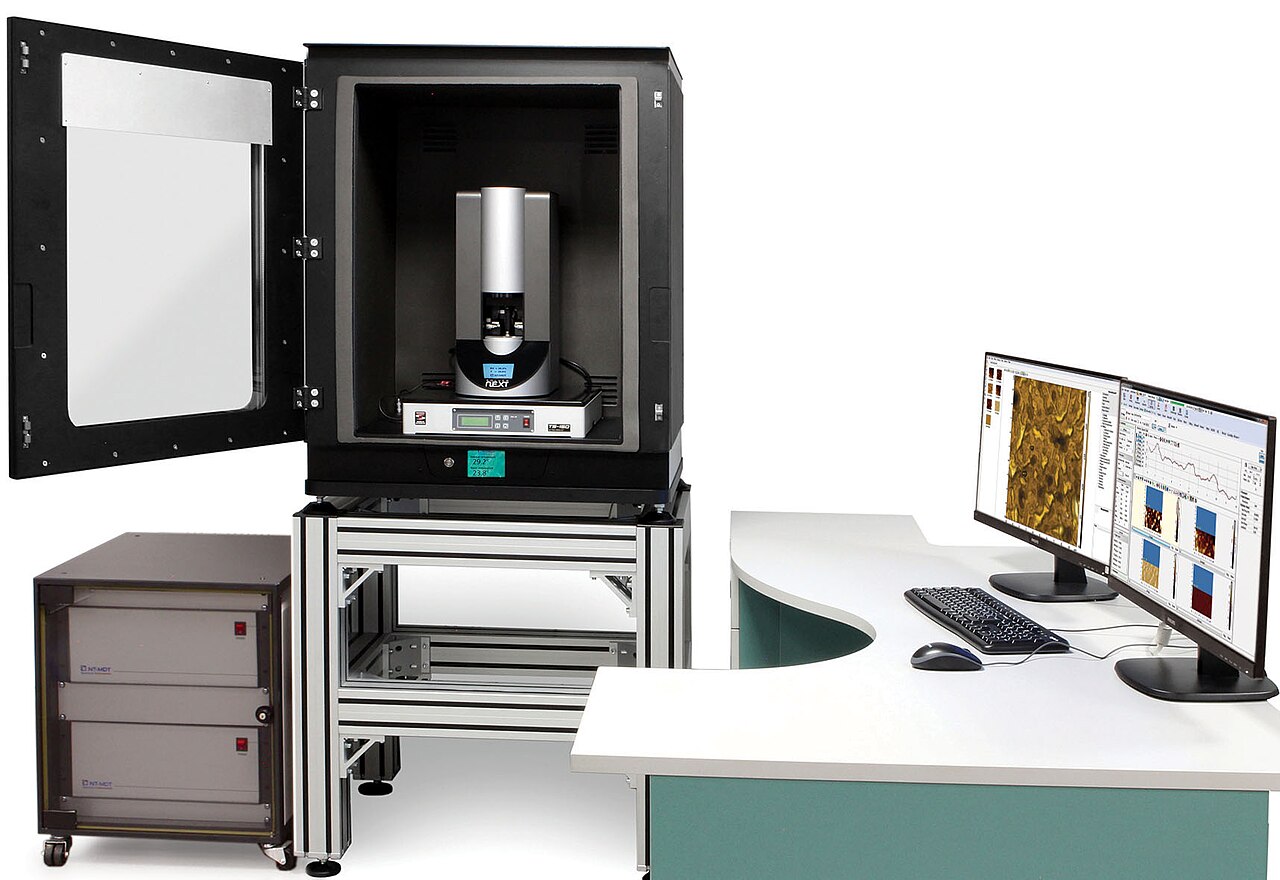
For microscopy, nanotechnology and scientific-instrumentation markets, the work points toward a more consequential role for AI than image post-processing. Instrument makers and research labs are increasingly interested in autonomous laboratories that can schedule experiments, optimize parameters and analyze results. Adding reliable physical manipulation extends that concept from automated measurement to automated construction.
The most immediate commercial impact may be in high-value research workflows: shared user facilities, national laboratories, university nanoscience centers and industrial R&D groups working on molecular electronics or quantum materials. In these settings, even modest gains in unattended operation and repeatability can matter because advanced microscope time and expert operator time are scarce.
The long-term market question is whether a single-tip system can be complemented by better task planning, standardized sample preparation, automated tip conditioning and eventually parallel probe architectures. If those pieces mature together, autonomous atomic assembly could become a specialized platform for rapid prototyping of nanoscale structures. It is unlikely to displace wafer-scale manufacturing, but it could occupy a valuable role analogous to precision machining or additive prototyping: slow relative to mass production, yet indispensable for creating and validating designs that other methods cannot make.
What to watch next
The next tests should focus less on ever more elaborate patterns and more on engineering evidence. Researchers will need to show that the system can complete a defined assembly recipe repeatedly, quantify its success and intervention rates, and safely detect when it should stop rather than compound an error. Demonstrations on additional surfaces and with different molecular species would test whether the computer-vision and control strategy is general rather than tailored to one experimental scene.
A particularly important benchmark will be coupling assembly to automated characterization. The strongest version of this approach would not just place molecules according to a predetermined image. It would build a structure, measure a target property, compare the result with a desired behavior and select the next structure to fabricate. That would turn the microscope into a closed-loop platform for active materials research.
ORNL’s demonstration is therefore best understood as progress in laboratory autonomy. It does not establish atom-by-atom manufacturing, nor does it prove that AI has independently discovered a useful material. It does show that the boundary between AI analysis and AI-directed experimental action is becoming more tangible at one of the most demanding scales in physical science.
Editor’s Take
I see the 25-hour run as the headline result, not the atom-scale artwork. Researchers have been able to manipulate individual atoms and molecules for decades; the commercial and scientific bottleneck has been the expert operator who must constantly interpret the instrument and correct the process. If an AI controller can reliably carry that burden, a microscope becomes less like a manual demonstration tool and more like an experimental production system.
The next numbers I would want are placement yield, completed moves per hour, recovery after failure and reproducibility across samples and tips. Without them, claims about electronics or quantum-materials applications remain directionally credible but premature. Still, the practical upside is real: reliable autonomous assembly could make scarce, expensive nanoscale experiments faster to run, easier to repeat and much more useful for testing ideas that cannot be fabricated any other way.
References
- Oak Ridge National Laboratory – https://ebs.publicnow.com/view/4C8049F72F57C5CB8BCAED53CA60272293FE40F3