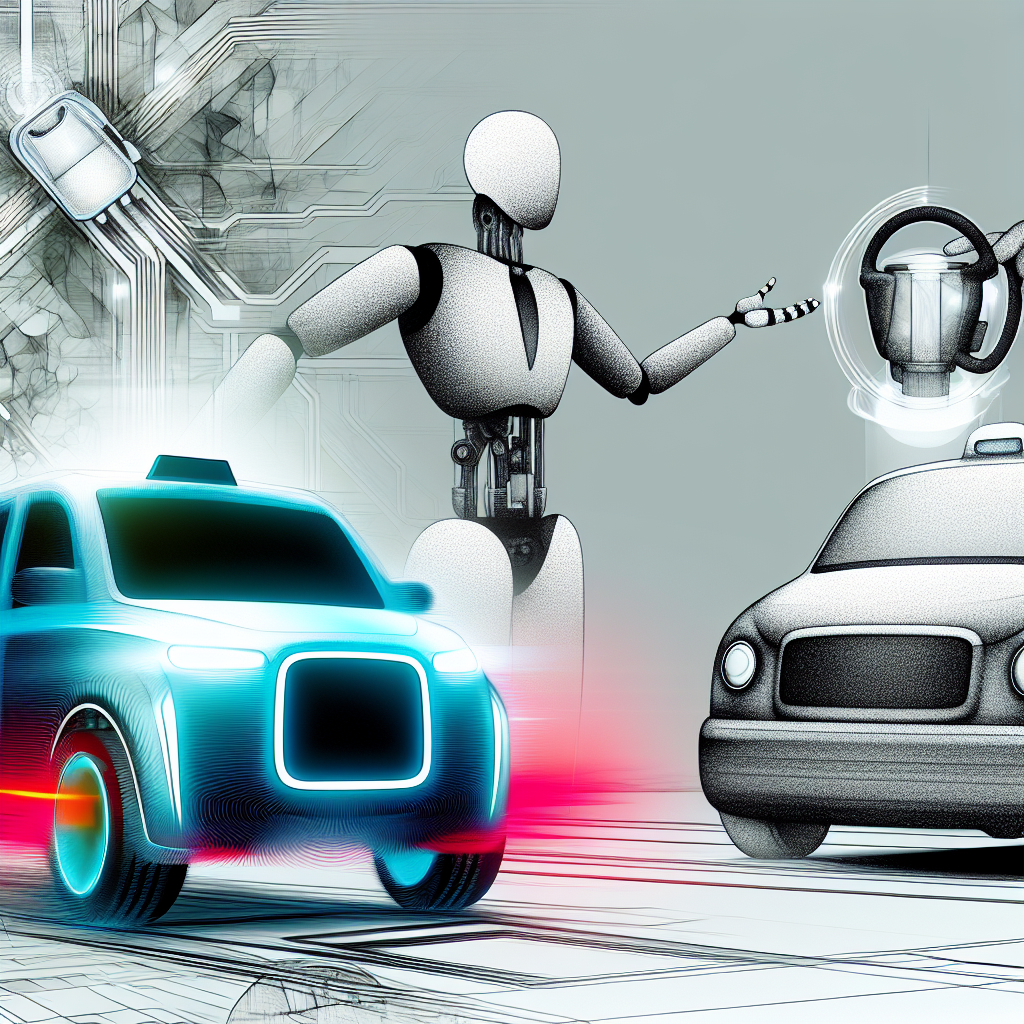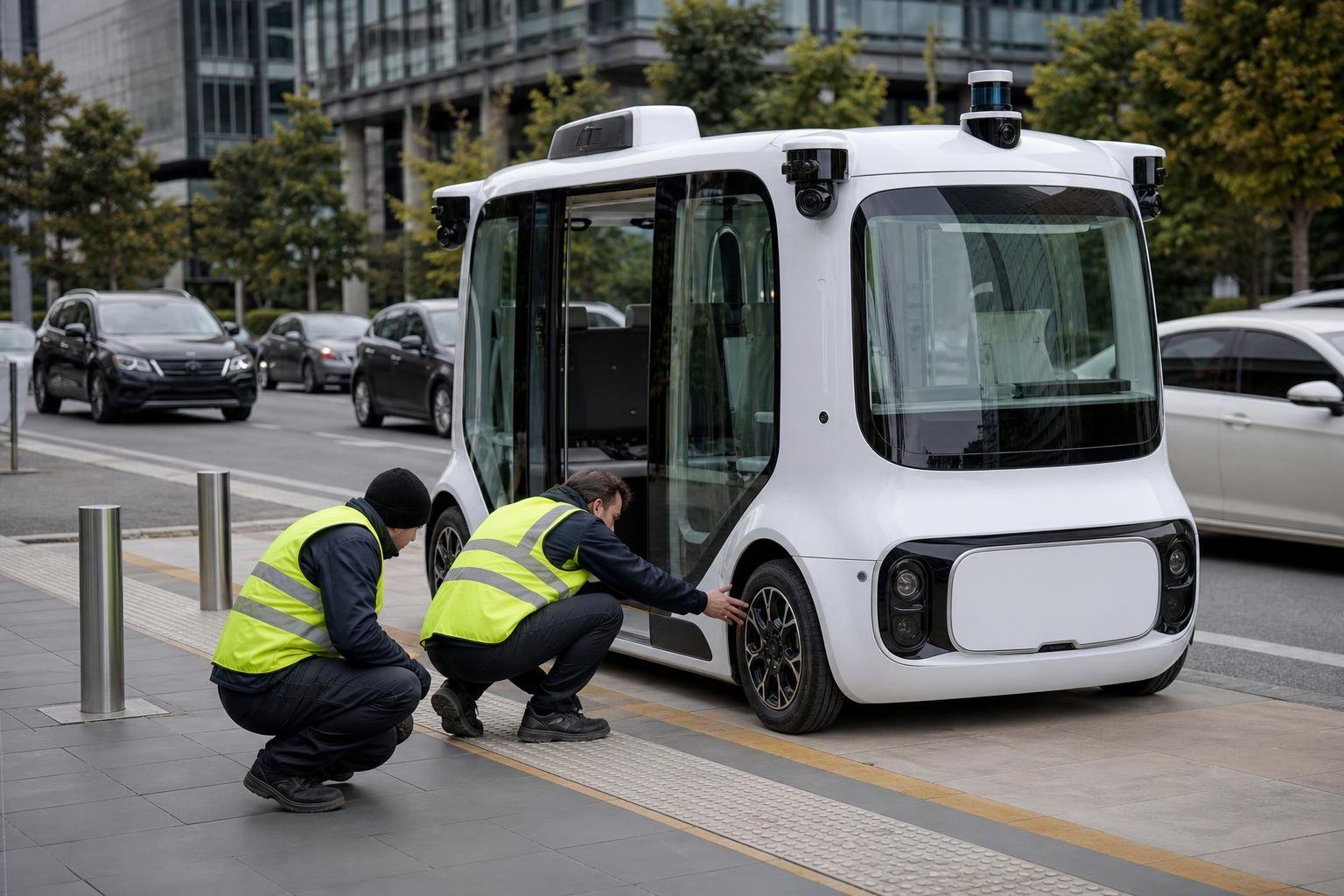
The U.S. Department of Transportation is moving more quickly to adapt federal vehicle-safety rules to a reality in which some cars may never have a driver’s seat, steering wheel or brake pedal. On June 25, the National Highway Traffic Safety Administration opened a proposed rulemaking that would let fully driverless light vehicles comply with federal brake standards without conventional foot-operated service-brake pedals or hand- or foot-controlled parking brakes.[1][2]
The proposal is the fifth in a wider effort to revise Federal Motor Vehicle Safety Standards, or FMVSS, that were largely written around a human being seated behind a wheel. It could remove a major design constraint for purpose-built robotaxis such as Zoox’s shuttle-like vehicle and Tesla’s planned Cybercab. But it also sharpens a central policy question: whether Washington is eliminating hardware requirements faster than it is establishing measurable standards for how automated driving systems must perform.
A brake standard built for software-controlled vehicles
FMVSS No. 135 governs light-vehicle brake systems. In its current form, the standard assumes a human operator applies braking force through a pedal and uses a separate parking-brake control. NHTSA’s proposal would revise those assumptions for a vehicle equipped with an automated driving system, or ADS, that has no manually operated driving controls.
The agency’s premise is straightforward: occupants of a genuinely driverless vehicle are passengers, not drivers. The vehicle should therefore be able to command service and parking braking through onboard systems, including the ADS, rather than requiring a person to operate conventional controls.[1][2]
That is not a proposal to weaken the underlying brake-performance requirements. NHTSA said it is not seeking AV-specific reductions in stopping-distance performance. Among the tests described in the proposal is a 100-kilometer-per-hour, or 62.1-mph, stop with a maximum stopping distance of 70 meters, roughly 230 feet, under specified test conditions.[2]
Instead, the proposed revision changes how regulators define and test the mechanism that initiates braking. For no-driver vehicles, a “service brake control” could be a component that translates an electronic command into physical braking action, including through a linear actuator or brake-by-wire architecture. Manufacturers could use specified electronic inputs for compliance testing in place of the standardized pedal force used for conventional vehicles. Stopping distance would be measured from the initial electronic braking command until the vehicle stops.[2]
The proposal preserves requirements for mechanical braking capability, antilock braking systems and other applicable standards. Regenerative braking may be part of the service-brake system, but required mechanical brakes must remain. NHTSA also draws a distinction between the primary service-brake control and a passenger-facing stop button. A rider’s request to stop would not itself become the vehicle’s main braking control.[2]
Another important limitation is that braking cannot rely only on an outside command. The relevant braking functions must be activated by onboard vehicle systems. That provision reflects the risks of depending entirely on a remote connection for a core safety function.
The fifth piece of a broader FMVSS rewrite
The brake proposal is part of DOT’s Automated Vehicle Framework, announced by Transportation Secretary Sean P. Duffy in April 2025. The program has three stated aims: prioritize safety in AV operations on public roads, remove unnecessary regulatory barriers and enable commercial deployment.[3]
Its practical task is to examine rules whose wording and test procedures assume a traditional vehicle layout. NHTSA’s research program reviewed 81 safety standards for their compatibility with ADS-equipped vehicles. Its final research volume, published in December 2025, addressed braking, electronic stability control, crashworthiness and unconventional seating arrangements, among other issues.[4]
So far, the agency’s modernization sequence includes standards covering:
- Transmission shift-position sequencing, starter interlock and transmission braking under FMVSS No. 102.
- Windshield defrosting, defogging, wiping and washing under FMVSS Nos. 103 and 104.
- Lamps, reflective devices and related equipment under FMVSS No. 108.
- Tire-selection and load-capacity placards under FMVSS No. 110.
- Light-vehicle braking under FMVSS No. 135.[4]
The earlier proposals illustrate the extent to which conventional standards are tied to a driver’s physical position. The March proposal for FMVSS Nos. 103 and 104 would exempt ADS-only vehicles with no manual controls from certain windshield wiping, defrosting and defogging requirements intended to support human-driver visibility. NHTSA’s view is that an ADS using exterior sensor suites does not necessarily depend on a windshield in the same way a person does.[5]
Similarly, an April proposal would let a manufacturer put the required tire-information placard on a vehicle’s left side or another practical location when a driver’s side is not defined.[6] These may appear to be narrow technical changes, but they matter for vehicles with bidirectional cabins, nontraditional seating and no dedicated operator position.
From exemptions to direct compliance
The immediate importance of the rulemakings is legal as well as technical. A vehicle that does not conform to applicable FMVSS generally cannot be made for sale or introduced into interstate commerce without an exemption or another legal basis. For purpose-built AV developers, that has made exemptions an essential bridge between prototype fleets and potential commercial scale.
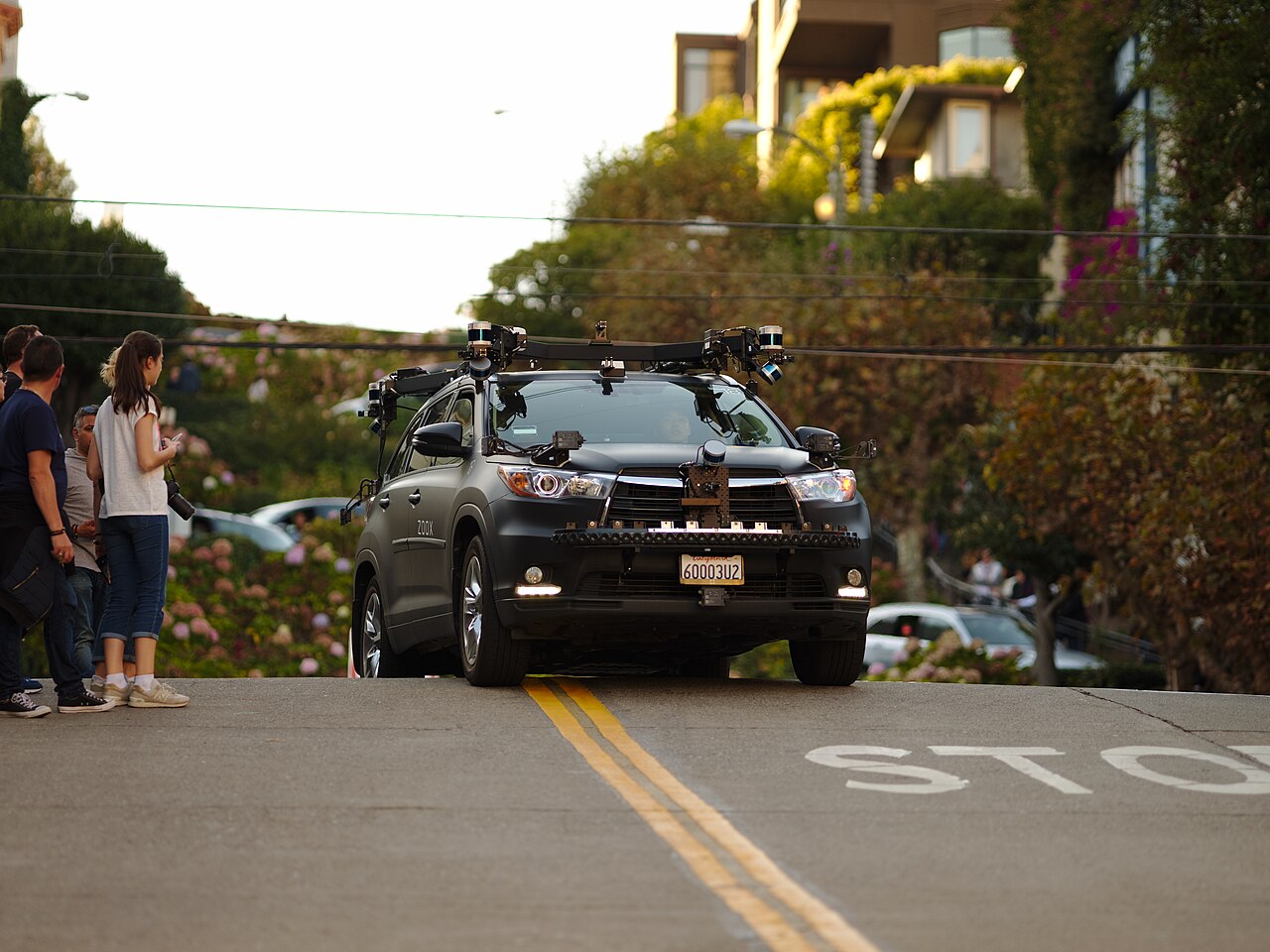
NHTSA expanded its Automated Vehicle Exemption Program, or AVEP, to domestically produced vehicles in April 2025. In August, it issued the first AVEP exemption for an American-built vehicle to Amazon-backed Zoox for its purpose-built robotaxi operating on U.S. public roads. The exemption required Zoox to remove or cover claims that the vehicle complies with all applicable FMVSS, underscoring that an exemption is not the same as full certification under the existing standards.[3][7]
The longer-term objective is to make vehicle-by-vehicle workarounds less necessary. If the standards themselves accommodate an ADS-only design while retaining relevant performance requirements, companies could certify eligible vehicles directly rather than depend on a limited exemption pathway.
That prospect is increasingly relevant as the industry shifts from retrofitting conventional passenger cars to designing vehicles around autonomy from the outset. The International Energy Agency reported that commercial Level 4 robotaxi services were operating in more than 20 cities globally and that the robotaxi fleet more than doubled in 2025 to about 8,000 vehicles across roughly 20 cities. The agency identified a growing move toward purpose-built, software-defined vehicle platforms.[8]
Fleet operation is central to the business case. Robotaxi and autonomous-truck operators can restrict vehicles to geofenced domains, monitor them centrally, update software frequently and spread expensive sensor and computing costs across vehicles with high utilization. Those same characteristics can give regulators more visibility than they would have over widely distributed privately owned autonomous cars.
Industry sees overdue modernization
AV developers and technology trade groups have broadly supported NHTSA’s direction. The Autonomous Vehicle Industry Association has argued that the industry has entered a commercialization phase and that federal rules need to catch up with vehicles designed without manual controls. Its chief executive, Jeff Farrah, called the failure to establish modern federal rules a dereliction of duty.[9]
The Consumer Technology Association has also endorsed the agency’s early modernization proposals, arguing that standards written for human-driven vehicles should be updated to accommodate vehicles without manual controls while preserving safety.[10]
For manufacturers, the brake proposal addresses more than the removal of a pedal. Pedals, steering columns, mirrors and a fixed driver-facing dashboard impose packaging constraints that can dictate an entire vehicle architecture. Removing them can enable more passenger space, symmetric cabins and designs optimized for shared fleet use. It can also eliminate components that have no functional role if the ADS performs every aspect of the driving task.
NHTSA Administrator Jonathan Morrison has framed the work as an effort to remove outdated design barriers while developing objective performance standards for automated vehicles.[1] The distinction matters: a rule that permits a different vehicle layout does not, by itself, certify that the automated system controlling that vehicle is safe in every condition.
The unresolved question: how should an ADS be judged?
Safety advocates do not necessarily contend that a vehicle with no human driver needs a brake pedal. Their concern is the sequencing of the federal effort. Advocates for Highway and Auto Safety President Cathy Chase has said there are no independent assurances that the technology is ready for broad deployment. Senior research director Shaun Kildare has argued that passengers need a dependable way to make a vehicle stop or exit if the ADS, a remote-assistance process or the operating environment fails.[9]
Those concerns extend beyond brake hardware. A comprehensive AV safety regime would need to address perception, decision-making, fallback behavior, cybersecurity, remote assistance, interactions with first responders and passenger controls during abnormal events. A passenger stop button may be useful, but it raises difficult questions about what the vehicle should do if it is in moving traffic, stopped in an unsafe location or unable to complete a requested maneuver immediately.
NHTSA has said it is separately developing objective national competency or performance standards for AV operations. Until those are established, the agency continues to rely on existing tools, including defect investigations, recalls and automated-driving-system crash reporting, to address unsafe behavior.[1]
As of July 6, the FMVSS No. 135 revision remains a proposal, not a final rule. Its importance lies in the direction it signals: federal regulators are beginning to separate the safety functions a vehicle must deliver from the human-operated controls through which conventional cars deliver them. Whether that modernization is matched by enforceable standards for the software taking over the driving task remains the larger test.
Editor’s Take
The practical value of this proposal is not that it makes braking easier; it makes certification less absurd for vehicles that were never designed to have a human driver. A pedal, steering column and driver-facing controls are costly architectural commitments in a shared autonomous fleet. If NHTSA can preserve objective stopping and mechanical-braking requirements while allowing electronic actuation, purpose-built robotaxis gain a clearer path from tightly managed pilots to repeatable production.
The key caveat is that compliant brake hardware is not proof of a safe driving system. The 70-meter stopping test at 100 km/h is a useful, measurable vehicle requirement, but it says little about whether the ADS detects a pedestrian, interprets a temporary work zone, handles degraded sensors or chooses the right braking profile before an emergency stop is needed. Watch whether DOT pairs these equipment-rule updates with credible, testable ADS performance expectations. Without that second layer, the industry may get cleaner vehicle packaging faster than it gets a durable public-safety case.
References
- National Highway Traffic Safety Administration – https://www.nhtsa.gov/press-releases/fmvss-updates-brake-pedal-requirements
- Federal Register, FMVSS No. 135 proposed rule – https://www.govinfo.gov/content/pkg/FR-2026-06-26/pdf/FR-2026-06-26.pdf
- U.S. Department of Transportation, Automated Vehicle Framework – https://www.transportation.gov/briefing-room/trumps-transportation-secretary-sean-p-duffy-unveils-new-automated-vehicle-framework
- National Highway Traffic Safety Administration, AV framework plan – https://www.nhtsa.gov/press-releases/av-framework-plan-modernize-safety-standards
- U.S. Department of Transportation, FMVSS Nos. 103 and 104 proposal – https://www.transportation.gov/regulations/federal-register-documents/2026-05023
- U.S. Department of Transportation, FMVSS No. 110 proposal – https://www.transportation.gov/regulations/federal-register-documents/2026-06254
- National Highway Traffic Safety Administration, Zoox AVEP exemption – https://www.nhtsa.gov/press-releases/nhtsa-issues-first-ever-demonstration-exemption-american-built-automated-vehicles
- International Energy Agency, Autonomous Vehicles – https://www.iea.org/reports/autonomous-vehicles
- Axios, autonomous-vehicle regulation coverage – https://www.axios.com/2026/07/01/autonomous-regulations-self-driving-trump
- Consumer Technology Association letter to NHTSA – https://www.cta.tech/media/0vhp1iej/cta-letter-to-nhtsa-re-fmvss-updates.pdf